Exploring a Culture with UNESCO 2030 Objectives and SWOT The Mayangna of Nicaragua
DOI:
https://doi.org/10.14738/assrj.511.4814Abstract
An exploration into one of Central America’s indigenous nations using a UNESCO 2030 Objective and a business SWOT. The authors have visited the Mayangna people and read about them as part of the empathy process. They are doing this with the hope of eventually creating a culturally sensitive program to help the Mayangna leadership achieve whatever goals they set for their nation and for their communities. This is a special region of a special country and quite remote from the typical tourist destinations. Through the work with the Autonomous University of the Caribbean Coast, introductions and access were obtained to the Sumu-Mayangna Nation. This work explores with one Indigenous Nation but there are more than 77 million Indigenous and Afro descendent persons in Latin America and Caribbean alone. Estimates are that there are 45,000,000 indigenous persons in more 800 different groups in Latin America. There are about 7.5 million Indigenous persons in Central America. In Nicaragua, the estimate is 520,000. In this paper, the focus is on one group with a methodology that may be helpful in assessing other indigenous groups in the future. The paper is an exploration of what we know to date in June 2018. The goal is to build to a multi-university interdisciplinary program working with the indigenous communities to accomplish the goals of those communities.
References
Bosawas Biosphere, http://www.unesco.org/mabdb/br/brdir/directory/biores.asp?code=NIC+01&mode=allURACCAN, http://www.uvm.edu/sistercity/URACCAN.html, accessed 18.10.2018
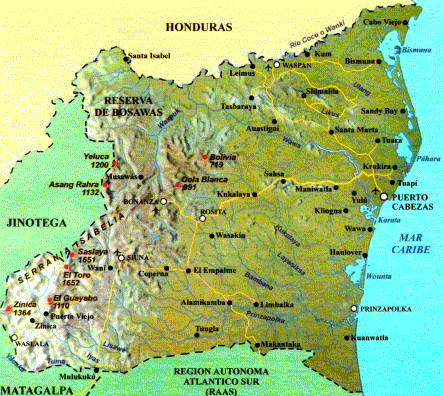
RAAN Map, http://www.aurorabeachfront.com/nicaragua/maps/m_raan.gif, Accessed 18.06.2018 Nicaragua laws 28 and 445, https://forestsnews.cifor.org/7862/despite-recognition-of-indigenous-land-rightsin-nicaragua-communities-still-losing-out?fnl=en Accessed 17.10,2017
UNESCO Objectives , http://www.ni.undp.org/content/nicaragua/es/home/sdgoverview/post-2015-development-agenda.html, Accessed, accessed 11.06.2018
CRES2018, Conferencia Regional de Educación Superior de América Latina y el Caribe- Córdova, 2018. cres2018@unesco.org.ve , accessed 14.06.2018
Hooker, Alta Blandon, CRES, 2018, Cordoba, Argentina, 11.06,2018.
Oxford Dictionaries, https://en.oxforddictionaries.com/definition/us/cosmovision, accessed 18.6.2018 th Congreso Universida 2018, the 11 International Congress on Post-Secondary Education, Habana Cuba, Feb 12-16, 2018 http://www.congresouniversidad.cu/, accessed 14.06.2018
Globe, Global Conference on Business and Economics, http://globeconference.org/, Accessed 14.06.2018 Humphrey Albert, Credited with Developing SWOT analysis, https://rapidbi.com/swotanalysis/, accessed 23.20.2017
Danver, Steven, Native Peoples of the World, Routledge, New York, 2015, page 158, https://books.google.com/books?id=vf4TBwAAQBAJ&pg=PA158&lpg=PA158&dq=How+many+Mayangna+today&source=bl&ots=HQGQ73Mjuh&sig=KutEKwqZMduxm-PISC8p3KZ-PGQ&hl=en&sa=X&ved=0ahUKEwiq3cDC_obXAhVr8IMKHaq1Dm4Q6AEIPjAE#v=onepage&q=How%20many%20Mayangna%20today&f=false, accessed 23.10.2017 https://www.researchgate.net/figure/315553210_fig2_Figure-2-Indigenous-territories-and-Bosawas-in-Nicaragua, Accessed 23.10.2017
Hinton, LaToya, “Perspectives on the Online Use of Languages in the Mayangna and Miskito Communities, November 7, 2016. https://rising.globalvoices.org/blog/2016/11/07/writing-a-lesson-about-views-on-languagein-the-mayangna-and-miskito-communities/, accessed 16.10.2017
Colls, Tom, “The Death of Language?” Today, British Broadcasting Company, October 19, 2009, http://news.bbc.,co.uk/today/hi/today/newsid_8311000/8311069.stm
Boyd, Brett, “Urbanization and the Mass Movement of People to Cities,” Grayline, Jan 17, 2017, https://graylinegroup.com/urbanization-catalyst-overview/Sole, Josep Maria, Arasa Raul et al. “Assessment of Climate Change in Nicaragua, Earth and Environmental Journal, Vol ^ number 3, July 2016, Pages 445-474, http://www.scirp.org/journal/PaperInformation.aspx?paperID=68368, Accessed 24.10.2017 Kronik, Jakob, and Dorte Verner, Indigenous Peoples and Climate Change in Latin America and the Caribbean, World Bank, 2010, https://books.google.com/books?id=MdAAGCpSXrUC&pg=PA74&lpg=PA74&dq=Climate+change+and+the+caribbean+coast+of+Nicaragua&source=bl&ots=Qa33ONIOev&sig=s-W_WP3uGGc2iUyi5zR7M-PL-PE&hl=en&sa=X&ved=0ahUKEwih--j92InXAhUB6IMKHeZeAt8Q6AEIVTAJ#v=onepage&q=Climate%20change%20and%20the%20caribbean%20coast%20of%20Nicaragua&f=false, accessed 24.10.2017
Jaccard, Helen, Chair War and Environmental Group of veterans for Piece, “Serious Challenges Remain for Nicaraguan Indigenous land ownership: A report from the March 2014 Nicaragua Network delegation to the North Caribbean Autonomous Region. www.nicanet.org/images/report-march-2014-delgation.pdfCPAL, Infographic: Indigenous Peoples in Latin America, https://www.cepal.org/en/infografias/los-pueblosindigenas-en-america-latina , accessed 16.06.2018.
Downloads
Published
How to Cite
Issue
Section
License
Copyright (c) 2018 Advances in Social Sciences Research Journal

This work is licensed under a Creative Commons Attribution 4.0 International License.