Cultural Heritage

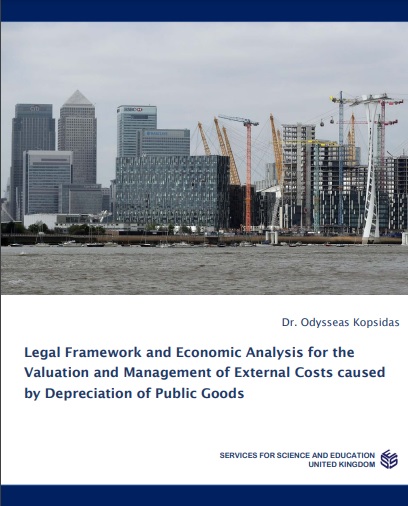
Legal Framework and Economic Analysis for the Valuation and Management of External Costs caused by Depreciation of Public Goods

Legal Framework and Economic Analysis for the Valuation and Management of External Costs caused by Depreciation of Public Goods

Assigning a value to a pubic good is a challenge mainly due to the lack of commercial value. This type of goods, being non marketable, cannot be validated by means of supply and demand. From the other, the evaluation is necessary. A number o economical and social parameters are affected by the assigned value of a public good and in turn, they affect the price of marketable goods. This kind of parameters are taxation, management and preservation of the environment, full use of natural and social resources. The provider of the good- usually the state- have to evaluate rationally and correctly the price in monetary units to avoid loss of capital or failure to preserve and protect the good, something that might lead to the final loss of the good. It therefore necessary the development of specific methodologies that will allow the direct and relatively easy evaluation of public goods. Directness and simplicity are the mainframe for the challenge faced in the present study. The abstract nature of the majority of public goods leads, at best, to difficulties in describing benefits and costs. In the worst case, a non-expert, a simple citizen asked to pay tax for such a provision, more often than not has complete lack of awareness even for the existence of the specific good, even if he benefits from it in everyday life.
Legal Framework and Economic Analysis for the Valuation and Management of External Costs caused by Depreciation of Public Goods Read More »

Technical-economic Evaluation of Urban and Natural Environment Programs

Technical-economic Evaluation of Urban and Natural Environment Programs

The estimation of the value of public goods is challenging for two reasons: (a) the classic methods of estimation are suitable for marketed goods and not for nonmarketed goods for which the supply – demand curve does not apply and (b) the variety and abstract nature of such goods cannot facilitate the quantization of any of their properties, whereas the good per se might not be perceived by the population that enjoy the benefit offered. This study presents an attempt to adapt and modify suitable methodological tools for the valuation of such goods in techno-economic analyses of upgrading the quality of the environment. A variety of programmes have been designed and studied in this work, including the enhancing of urban environment, the protection and restoration of cultural heritage, noise pollution reduction, wetland restoration and port restoration. The diverse nature of these programmes necessitates the use of a versatile and easy – to – apply generalized methodology, readily adaptable to each case.

Technical-economic Evaluation of Urban and Natural Environment Programs Read More »