
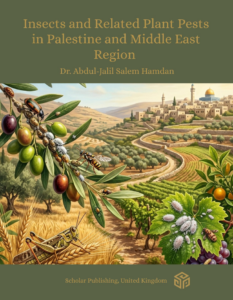
Insects and Related Plant Pests in Palestine and Middle East Region
Abdul-Jalil Salem Hamdan
- Preface
- This book, Insects & Related Plant Pests in Palestine and Middle East Region, has grown out of my years of teaching entomology at Hebron University and conducting field research on pest management in Palestine and the surrounding region. The idea took shape gradually as I realized that students, extension workers, and even practicing agronomists lacked a single, accessible, and regionally relevant reference that covers both the biology of major pests and practical management strategies under our unique environmental and agricultural conditions. The Middle East is not merely a geographic crossroads—it is also a crossroads of pests. Our hot, dry summers, mild winters, and diverse cropping systems, ranging from citrus and olives along the coastal plains to stone fruits in the highlands and date palms in the desert valleys, support a complex array of arthropod pests. Many of these pests are cosmopolitan, but they often behave differently under our local climatic and cultural conditions than they do in other regions where they have been more extensively studied. Furthermore, the continuous movement of plant material across borders has introduced invasive species—such as the tomato leafminer (Tuta absoluta), the red palm mite (Raoiella indica), and the red palm weevil (Rhynchophorus ferrugineus)—which now threaten our food security and demand urgent attention. This book is designed as a practical guide and a teaching resource. It is organized by insect order and family, with each pest entry covering taxonomy, geographic distribution, host plants, morphology, life history, economic importance, and—most critically—management options. I have placed strong emphasis on Integrated Pest Management (IPM), because the days of relying solely on broad-spectrum insecticides are over. Resistance is rampant, natural enemies are too valuable to destroy, and consumers increasingly demand residue-free produce. Special attention is given to biological control agents—parasitoids, predators, and entomopathogens—that can regulate pest populations if we learn to protect and augment them. Cultural practices, monitoring tools (pheromone and sticky traps), plant resistance, and selective chemicals (insect growth regulators, spinosad, avermectins) are all discussed within an IPM framework. Wherever possible, I have drawn on local research from Palestine, Israel, Jordan, Egypt, Turkey, Syria, and Lebanon, complemented by global knowledge. The book is intended for several audiences: undergraduate and graduate students in plant protection, entomology, and agriculture; extension specialists who advise farmers; and growers who wish to understand the pests in their fields and orchards. I have tried to keep technical language clear and have included many illustrations, life-cycle diagrams, and tables to aid identification and decision-making. I am deeply grateful to my teachers, colleagues, and students who have contributed to my understanding of entomology over the past decades. Special thanks go to the staff of the Plant Protection Department at Hebron University, to the farmers who allowed me to work in their fields and shared their practical wisdom, and to the many researchers whose published work—cited in the extensive reference list—forms the scientific backbone of this text. I also acknowledge my family for their patience and support during the long hours of writing and revision. Any errors or omissions are mine alone. I welcome feedback from readers, and I hope this book will serve as a useful tool in the ongoing effort to produce healthy crops while safeguarding our environment for future generations.
Published
- June 22, 2026
Categories
Copyright
- Copyright (c) 2026 Abdul-Jalil Salem Hamdan
License
This work is licensed under a Creative Commons Attribution 4.0 International License.